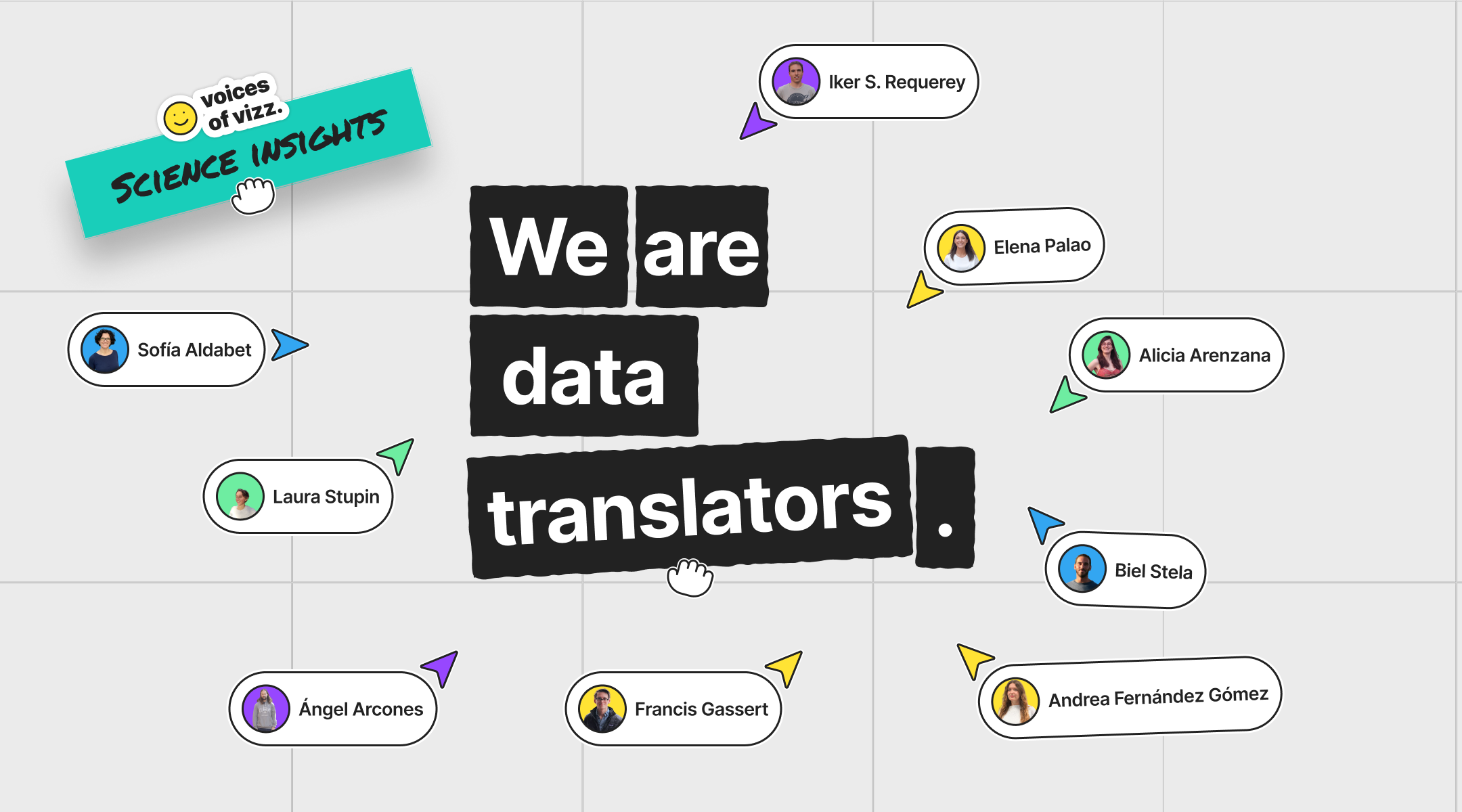
In the first blog of the Voices of Vizz series, we showcased some of the projects we've worked on and the magnitude of the expertise that goes into creating something that's often more than “just” a map. Today, we’re diving deeper into the heart of what we do: data translation.
What is data translation?
For us, data translation is understanding, contextualizing, and presenting data in a way that’s meaningful to the people we work with and the users of the products we co-create. It’s building the bridge between raw data and insightful decisions that can change the way people think, act, or move in the world.
Imagine you have tons of data, but it’s not clear what it means or what to do with it. That’s where we come in. We start by asking questions: What’s the problem here? And, what do you want to achieve? This phase, which we call the discovery phase, is where most of the magic happens.
The discovery phase:
Our process begins here. During this phase we answer the questions mentioned above and explore the data together with our clients. This is where we uncover what they really need, and offer our expertise, often beyond what they initially asked for.
Take the Environment and Climate Change Canada (ECCC) funded “Lowlands Spatial Data” platform that we’re currently developing. The idea was to create a platform where both indigenous and western science can be referenced to tackle environmental issues in the Hudson and James Bay region. During the discovery phase, we found out that the indigenous communities involved had sensitive data they didn’t want to share, due to historical patterns of extraction and exploitation from Western institutions.This insight shifted our strategy. Instead of attempting to gather sensitive community knowledge, we focused on surfacing public scientific data that is often buried in academic papers and technical repositories. By bringing datasets like regional carbon stocks and water trends into an open, accessible tool, we created a lightweight baseline to put evidence directly into local hands.
Similarly for Skytruth - for which we did all the data processing for protection coverage and all the other indicators - we faced a critical challenge. Our client was concerned that our results should align closely with external sources. However, we found discrepancies due to several factors:
- Some providers shared newer data with us than they had publicly available, leading to differences in statistics.
- External sources couldn’t share their full datasets due to confidential areas.
- Issues with the methodologies and use of different projections for statistical calculations.
To address these discrepancies, we documented our methodology, conducted a comprehensive Quality Assurance (QA) process, compared our results with source data to identify and explain potential differences and provided clear explanations for each number or insight. This aspect of our work is often hidden but truly essential.
To sum it up, the discovery phase allows us to go beyond data science and into the realm of co-creating solutions that are relevant, actionable, and respectful of the client’s needs and constraints. From this co-created plan, we deliver a final product.
We’ve got range:
As you’ve read in our first blog, while maps are part of our toolkit, we also provide digital tool services such as:
- Decision Support Tools: For AmazoniaForever360+ we recently added AI summaries - a feature thanks to which users can select various indicators to create a dashboard and get an AI summary of what these indicators mean.
- Interactive Dashboards: For its Deforestation-Free tool, Unilever trusted us with creating a dashboard and adding the relevant data layers to trace palm oil-linked deforestation.
- Storytelling Platforms: For The Living Planet Data Hub developed in collaboration with WWF Canada, we helped build a user-friendly interface that visualizes and analyzes ecological indicators, protection metrics, and restoration priorities across Canada.
As well as various consultancy services, such as, but not limited to:
- Environmental Storytelling: We collaborated with Mongabay on redesigning its English-language news website. We conducted strategic workshops and crafted a user-friendly design that integrated innovative features like advanced site search, multimedia support, and flexible templates for a variety of content types.
- Strategic Advisory: We advised The Nature Conservancy, from conceptualization to implementation, ensuring that the Soils Revealed platform met the vision of an engaging and impactful product - leveraging the best available soil data, environmental information, and computer simulations for sustainable land management.
- Scientific Advisory and Data analysis: We provided scientific and technical expertise, guiding the development of a user-friendly, map-based platform for AFoCO's diverse projects across Asia. Our role included consolidating and categorizing data from multiple projects, developing a scalable data model to accommodate future data, and designing and implementing both the platform and a robust back office for daily use by AFoCO members.
We hold domain knowledge:
What truly sets our team apart when dealing with so many different client needs and projects is our internal expertise and background. First, our approach centers our clients, which means we work to define solutions together. Second, our team has a background in various fields which means we can suggest solutions that might not have been on the table to start with.
We have in-house experts for almost everything:
- Environmental Science and Climate change: Sofia (environmental risks and urban planning) and Elena (hydrology).
- GIS and Remote Sensing: Alicia, and Biel.
- Specialized Knowledge: Angel (biology), Iker (solar physics), and Francis (climate data & tech)
- Recent additions: Laura (data science, and field data) and Andrea (spatial data analysis and environmental mapping).
Fun fact: In a recent project for the Seychelles, Sofia’s expertise in coastal ecosystems helped highlight critical indicators for sea-level rise adaptation.
The power of data translation.
In the world of data, there’s often a chasm between raw information and actionable insight. Our role as translators is to bridge this gap, transforming data into solutions that drive meaningful change.
What sets us apart is our commitment to being more than just data scientists: We’re collaborators, advisors, and strategists. Thanks to our internal expertise, we help our clients uncover what their data means and what actions it can inform.
Whether you’re facing data challenges or seeking to leverage impactful insights, we’re here to translate data into action.